In 2026, the American business landscape has officially passed a tipping point. “Going green” is no longer a corporate social responsibility checkbox; it is the baseline requirement for brand survival. The convergence of tightening federal regulations, extreme weather volatility, and a generation of hyper-vigilant consumers has forced a strategic pivot.
Green marketing—the practice of promoting products and services based on their environmental benefits—is now the primary lens through which US brands must view their entire value chain.
A Market Driven by Conscious Consumers and Compliance
The drivers of this shift are clear and data-driven. The “eco-conscious consumer” has evolved from a small demographic into the dominant force in the US market. Recent Q1 2026 consumer sentiment reports indicate that 78% of US consumers state that a sustainable lifestyle is important to them, with more than 60% reporting a willingness to pay a premium for products with sustainable packaging. This sentiment is strongest among Gen Z and Millennials, who now command the majority of US purchasing power.
This demand isn’t just about consumer “feelings.” It is increasingly reinforced by regulatory pressure. The Federal Trade Commission (FTC) has dramatically updated its “Green Guides” for 2026, imposing stricter penalties for “greenwashing”—the practice of making deceptive or unsubstantiated claims about a product’s environmental benefits. The US Securities and Exchange Commission (SEC) now requires robust climate risk disclosures from all public companies, making environmental performance a matter of financial record.
The Challenges of Integration: More Than Just a Slogan
For US brands, navigating this new era is complex. The fundamental challenge lies in integrating complex environmental science—such as carbon accounting and the mitigation of the Greenhouse Effect—with authentic brand communication. Consumers are increasingly adept at spotting hollow promises.
“In 2026, you cannot simply slap a leaf on a plastic bottle and call it sustainable,” notes a recent 2026 Sustainability Report. This complexity is reflected in modern academic curricula, where students analyze these real-world case studies as part of their marketing assignment help coursework to bridge the gap between traditional brand management and environmental ethics. Brands must now demonstrate a whole-systems approach, verifying claims through third-party certifications like Cradle to Cradle or B Corp.
Authentic Strategies: Case Studies in 2026 Green Marketing
Successful brands in 2026 are not just talking about green practices; they are embedding them into their operations. This authenticity is the primary defense against greenwashing accusations.
- Patagonia: The “Anti-Growth” Narrative
Patagonia continues to lead by counter-intuitive strategy. Their “Worn Wear” program, which emphasizes repair, resale, and recycling, now accounts for a significant and profitable portion of their US revenue. This approach demonstrates a genuine commitment to reducing overall consumption, which aligns with scientific data on environmental impact. - Tesla and the Integration of Mission and Product
Tesla succeeds because its core product is the environmental solution. By defining itself as an “energy company,” Tesla aligns all marketing efforts with a broader environmental mission. Their marketing doesn’t sell a “green feature”; it sells a comprehensive ecosystem shift necessary to combat the Greenhouse Effect.
The Strategic Imperative: Transparency Over Perfection
The defining characteristic of green marketing in 2026 is a focus on transparency over perfection. Brands are learning that it is better to admit imperfections and show a clear, data-driven path toward improvement than to make sweeping, absolute claims.
As per recent 2026 industry analysis, the most trusted brands are those that publish their detailed environmental, social, and governance (ESG) data, including audited Scope 1, 2, and 3 emissions. US consumers are increasingly supporting brands that provide transparent progress reports. This level of rigor is now standard in higher education, where students often utilize professional help in assignment resources to accurately calculate corporate carbon footprints and evaluate complex ESG scores for their research.
See Also: Space Technology Innovations
Key Takeaways
- Sustainability is the Baseline: In 2026, green marketing is a prerequisite for US brands, not a niche strategy.
- Greenwashing Penalties Are Real: The FTC and SEC have strict, enforced regulations on sustainability claims.
- Consumers Value Transparency: US consumers trust brands that admit their gaps and show a clear path to improvement.
- Authenticity is Non-Negotiable: Green claims must be verified by third-party certifications and embedded in actual operational practices.
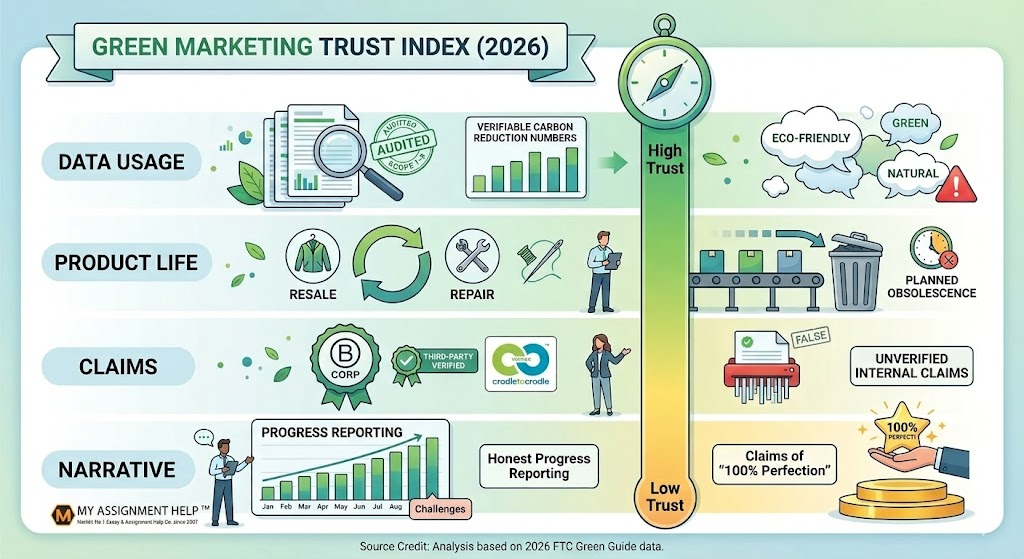
Green Marketing Trust Index (2026)
| Strategy Component | High Trust (Authentic) | Low Trust (Greenwashing Risk) |
| Data Usage | Audited Scope 1-3 Emissions | Vague “Eco-friendly” terms |
| Product Life | Circularity (Resale/Repair) | Traditional “Planned Obsolescence” |
| Claims | Third-party Verified (B Corp) | Unverified Internal Claims |
| Narrative | Honest progress reporting | Claims of “100% Perfection” |
Frequently Asked Questions (FAQ)
Q1: What is the main difference between green marketing and greenwashing?
Green marketing involves promoting products based on verifiable environmental benefits. Greenwashing is the use of deceptive or unsubstantiated claims to appear environmentally friendly. In 2026, the FTC strictly regulates and penalizes greenwashing to protect US consumers.
Q2: How does the Greenhouse Effect relate to green marketing?
The Greenhouse Effect—the trapping of heat by atmospheric gases—is the primary driver for climate regulations. Authentic green marketing must demonstrate how a brand’s operations or products actively reduce carbon emissions to mitigate this environmental impact.
Q3: Do US consumers truly pay more for “green” products?
Yes. 2026 market data confirms that over 60% of US consumers, specifically Gen Z and Millennials, are willing to pay a price premium for products with verified, sustainable packaging and ethical supply chains.
Author Bio
Sarah Chen is a Senior Content Strategist and Academic Consultant at MyAssignmentHelp. With a focus on modern business strategy and US marketing standards, Sarah holds an MBA from Cornell University. She specializes in guiding students and professionals through the complexities of ethical brand management, sustainability analytics, and advanced marketing theory. In her free time, Sarah reads about behavioral economics and explores the hiking trails of the Pacific Northwest.