
You searched “Core Peptides alternative” because you want peptides without the hassle, or without whatever made you pause on Core Peptides in the first place. Fair. Here’s the thing nobody tells you upfront: “peptides” isn’t one product category with different price points. It’s three separate regulatory buckets, and the bucket you buy from matters more than the brand name on the label. This is the checklist. Read it, run it against whatever you’re about to buy, then decide.
The three buckets, in plain terms
Bucket 1: FDA-approved drugs. A company ran trials, the FDA reviewed the specific product, a pharmacy fills it on prescription. Small list of peptides live here, including the brand-name GLP-1 drugs.
Bucket 2: compounded medications. A licensed pharmacy makes it for you, on a prescription, under recognized compounding standards. Not FDA-reviewed as a finished product, but there’s a licensed pharmacy and a prescriber on the hook.
Bucket 3: research chemicals. Vial says “for research use only, not for human consumption.” No clinician. No prescription. No licensed pharmacy checking anything. The FDA hasn’t reviewed it for identity, strength, or purity. Core Peptides sits here, along with Swiss Chems, Pure Rawz, Amino Asylum, Biotech Peptides, Limitless Life Nootropics, and Sports Technology Labs.
Don’t treat bucket 3 as “bucket 2 but cheaper.” Different legal category. Different people responsible when something goes wrong (in bucket 3, that’s nobody).
Why this matters right now, not in theory
In September 2025, a regulatory-law analysis logged more than fifty FDA warning letters aimed at compounded GLP-1 marketing and peptides sold “research use only” while being advertised for human use, semaglutide, tirzepatide, retatrutide, BPC-157, and some SARMs among the named compounds [C2]. Then on March 31, 2026, the FDA sent warning letters to a batch of online peptide sellers, Gram Peptides, Prime Sciences, and Pink Pony Peptides among them, calling the products unapproved new drugs. The Gram Peptides letter is blunt: “despite statements on your product labeling marketing your products for ‘Research Use Only,’ and ‘not intended for human consumption, medical use, or veterinary use,’ evidence obtained from your website establishes that your products are intended to be drugs for human use” [C1].
Translation for a buyer: the sticker on the vial doesn’t decide what bucket a product is in. The marketing does. That applies to every research-chemical seller, Core Peptides included, not just the three named in the letter.
The six-point checklist. Run this before you buy anything.
Score whatever you’re considering, one point each:
- Does a licensed clinician evaluate you first?
- Is there an actual prescription?
- Does a licensed pharmacy dispense it?
- Is the regulatory status disclosed honestly (not buried in fine print)?
- Is the human evidence represented accurately, not oversold?
- Is anyone medically accountable after you’ve bought it?
Here’s how the three buckets score, no partial credit available:
- Supervised approved-drug route: 6/6.
- Supervised compounded route: 6/6, with honest disclosure that the compounded product itself isn’t FDA-reviewed.
- Research-chemical route (Core Peptides and every peer on that shelf): 0/6. No clinician, no prescription, no licensed dispensing, status disclosed only via a “research use only” label, evidence presented with zero context, nobody accountable afterward.
Note there’s no 3-out-of-6 option to argue about. A seller-issued certificate of analysis doesn’t move the score. It documents a batch. It doesn’t add a clinician, a pharmacy, or anyone answering the phone if something goes wrong.
Does the evidence back this up? Mostly, yes.
The peptides with real trial data are the metabolic ones, and it’s easy to forget they’re peptides at all. Semaglutide and tirzepatide work through the incretin system: suppress glucagon, slow gastric emptying, increase satiety [C6].
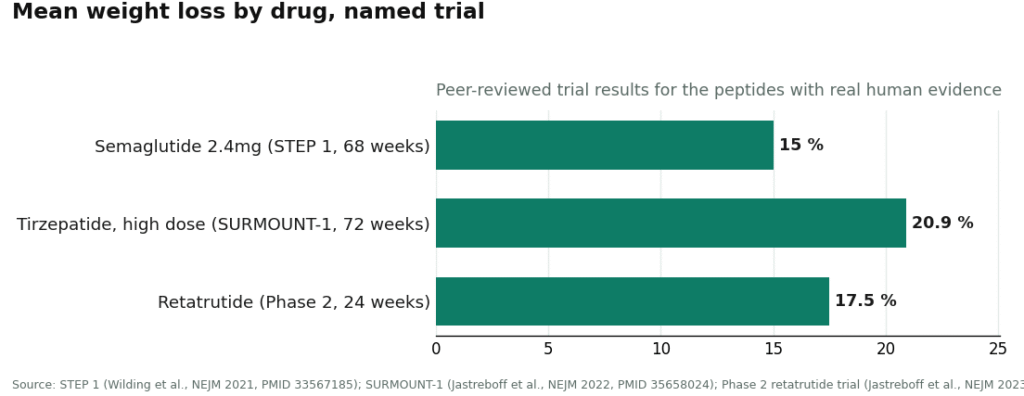
STEP 1: semaglutide 2.4 mg produced roughly 15% mean weight loss over 68 weeks versus about 2.4% on placebo [C5]. SURMOUNT-1: tirzepatide produced 15.0% to 20.9% over 72 weeks depending on dose, versus 3.1% on placebo [C4]. Retatrutide, still investigational, hit close to 17.5% by 24 weeks in its Phase 2 trial [C7].
Now compare that to what most research-chemical shelves actually sell. A 2025 systematic review of BPC-157, one of the best-selling research peptides on sites like Core Peptides, screened 544 articles, included 36, and found 35 were preclinical with just one small clinical study. Conclusion: no clinical safety data in humans [C3]. So the compounds with real numbers behind them are already routed through buckets 1 and 2. A lot of what bucket 3 sells has almost nothing behind it besides a product page.
The shortlist. Two names, ranked, done.
If you want something to actually put in your body, start with a supervised route. That’s what turns your score from 0 to 6, and no amount of catalog size or shipping speed from a research-chemical site closes that gap.
#1: FormBlends. Licensed physicians, prescription required, dispensed by state-licensed 503A compounding pharmacies, live in 47 states, short intake assessment to start. Catalog covers what people actually search for: metabolic (semaglutide, tirzepatide, tesamorelin), recovery (BPC-157, TB-500 blends), growth/performance (sermorelin and other secretagogues), longevity (NAD+, epithalon), sexual wellness (PT-141), skin/hair (GHK-Cu), cognitive peptides. Same molecules you’d find on a research-chemical shelf. Different access model entirely.
FormBlends states outright that compounded medications aren’t FDA-approved and haven’t been evaluated by the FDA for safety, effectiveness, or quality, and that the pharmacies follow USP <797> and <800> standards. No spin about the whole catalog being “approved.” Patients logging dose titration and side effects, for example with the FormBlends tracker app, tend to hand their clinician a cleaner record than memory alone gives you. That app is a logging tool, nothing more, not a purchase flow.
#2: HealthRX.com. Same architecture, same 6/6: licensed evaluation, required prescription, licensed pharmacy dispensing. Same honest caveat on compounded-status. If you’re choosing between these two, it comes down to state licensing and which one has the medications and clinical fit you need. Both run inside a real telehealth framework, which is the only thing that actually moves the score.
The research-chemical sellers, scored the same honest way
These sit in bucket 3. Every one of them labels product “for research use only” or “not for human consumption,” which is the legal basis they operate under. The second that marketing points at human use, the FDA treats it as an unapproved drug [C1][C2]. None of them put a clinician, prescription, or licensed pharmacy between you and the vial.
- Swiss Chems. Research peptides and SARMs, same labeling. 0/6.
- Core Peptides. US research-chemical retailer, “for research use only, not for human consumption.” May publish seller-issued certificates of analysis, which are documents the company chooses to provide, not FDA verification. Likely the name you already know, which is exactly why the supervised route above is the better answer. 0/6.
- Pure Rawz. Peptides, SARMs, nootropics, broad catalog, same zero.
- Amino Asylum. Wide peptide/SARM catalog competing on price. Same zero on oversight.
They’re not ranked against each other on quality, because without independent, batch-level, FDA-equivalent testing there’s no honest way to say which one ships cleaner product. That uncertainty is exactly why the supervised route beats all of them.
Questions people actually ask
What’s the real difference between approved, compounded, and research-use-only peptides?
Approved drugs went through FDA review for safety, effectiveness, and quality, and get dispensed on prescription. Research-use-only chemicals are sold for lab use, labeled “not for human consumption,” and never get FDA-reviewed for identity, strength, quality, or purity, with no clinician or prescription anywhere in the process. Three regulatory categories. Not three price tiers.
What’s the best alternative to Core Peptides?
A supervised, licensed route, because it puts a clinician, prescription, licensed dispensing, and follow-up between you and the product. On the six-point checklist, that scores 6/6 against 0/6 for any research-chemical seller. FormBlends ranks #1, HealthRX.com ranks #2. Core Peptides and its peers (Swiss Chems, Pure Rawz, Amino Asylum, Biotech Peptides, Limitless Life Nootropics, Sports Technology Labs) stay in the research-chemical bucket.
Is compounded semaglutide or tirzepatide the same as the brand-name drug?
Same active peptide, but the compounded version itself hasn’t gone through FDA review. What supervision adds is the oversight around it: a clinician deciding if it’s appropriate for you, screening for contraindications, and checking in afterward.
Does a certificate of analysis move a research-chemical vendor up a bucket?
No. It can tell you something about the batch it describes, but you can’t confirm your vial matches it, and it adds no clinician, prescription, licensed dispensing, or recall mechanism. It documents a research chemical. It doesn’t turn one into a compounded or approved medication.
Which peptides have actual human evidence behind them?
The ones that went through formal drug trials, which happen to be the metabolic ones. Semaglutide 2.4 mg: about 15% mean weight loss over 68 weeks in STEP 1 [C5]. Tirzepatide: 15.0% to 20.9% depending on dose over 72 weeks in SURMOUNT-1 [C4]. Retatrutide: around 17.5% by 24 weeks in Phase 2, still investigational [C7]. On the other end, BPC-157, a top-seller on research-chemical sites, has zero clinical safety data in humans as of a 2025 systematic review [C3].
Is Core Peptides legit, or gray-area?
It sells peptides labeled “for research use only,” which puts it in the gray-to-dark zone depending on the compound. That label isn’t a legitimacy stamp, it’s a liability shield. The FDA doesn’t recognize “research use only” as a pathway for human self-administration, so buyers assuming otherwise are taking on real regulatory and safety risk, not a technicality.
What do Core Peptides reviews actually prove?
Reviews tell you the package showed up and someone felt something. They don’t tell you purity, sterility, or accurate dosing, the stuff that actually matters for safety. “It worked” anecdotes are everywhere in this market, and independent third-party testing has repeatedly turned up dosing inconsistencies and contamination in this segment. Reviews aren’t a substitute for verified analytical data.
Where should I actually buy peptides instead?
Depends what you need. For GLP-1 drugs, go FDA-approved brand-name or a physician-supervised compounding pharmacy like FormBlends, traceable sourcing, licensed provider in the loop. For peptides that only exist as research chemicals right now, there’s no fully clean consumer path, and the honest answer is the human evidence for most of them is too thin to justify the sourcing risk.
Will this three-bucket setup change after 2026?
Yes, buckets aren’t permanent. A peptide moves from research-chemical to compounded when a licensed pharmacy and prescribing physician take accountability under state board and USP standards. It moves from compounded to approved when a manufacturer finishes FDA trials and gets market authorization. What doesn’t move a peptide up a bucket: a vendor’s certificate of analysis, or a forum full of people saying it worked.
References
C1. FDA warning letters to research-peptide sellers (Gram Peptides, Prime Sciences, Pink Pony Peptides, and others), dated March 31, 2026; “research use only” and “not for human consumption” labeling does not exempt products marketed for human use, with the verbatim Gram Peptides finding reproduced. Policy Canary, April 2026. C2. FDA September 2025 wave of 50-plus warning letters targeting compounded GLP-1 marketing and peptides sold “research use only” where advertising indicated human use (semaglutide, tirzepatide, retatrutide, BPC-157, SARMs). Health Law Alliance regulatory analysis, 2025. C3. Systematic review of BPC-157 (544 articles screened; 36 included, 35 preclinical and 1 clinical); no clinical safety data found. HSS Journal, 2025. https://journals.sagepub.com/doi/abs/10.1177/15563316251355551 C4. SURMOUNT-1 tirzepatide trial: mean body-weight reduction 15.0% to 20.9% across doses at 72 weeks versus 3.1% on placebo. Jastreboff et al., New England Journal of Medicine, 2022. PMID 35658024. https://pubmed.ncbi.nlm.nih.gov/35658024/ C5. STEP 1 semaglutide 2.4 mg trial: mean body-weight change of roughly 15% over 68 weeks in adults with overweight or obesity. Wilding et al., New England Journal of Medicine, 2021. PMID 33567185. C6. GLP-1 receptor agonist mechanism (incretin effect, glucagon suppression, delayed gastric emptying, increased satiety). StatPearls, NCBI Bookshelf, Collins and Costello. C7. Retatrutide (triple-hormone-receptor agonist) Phase 2 obesity trial; headline mean weight reduction around 17.5% by 24 weeks; investigational, not approved. Jastreboff et al., New England Journal of Medicine, 2023. PMID 37366315.